The Riflemaker is one of those few galleries that make you feel at home while simultaneously accommodating for a plethora of sensory stimulation all within its cosy Victorian layout. Ring ring, creak creak -- this time its little door opens up to the mystery land of voodoo.
Now, voodoo is not just about sticking pins into grimacing evil dolls. It is a universe of spirits, a creative act unleashing the fire and forces within primal man, and a religion practiced by over 30 million people. Packing psychedelic paintings, centuries of sacrificial practice from the deepest corners of the world, beeswax cauldrons, repetitive rhythms of beating drums, Adolf Hitler and more, the gallery becomes something of an educational centre, a chemical lab and your grandma’s attic in one.
On the ground floor I was greeted by an influx of information about the mystical practice; stories and histories written and displayed, slave trade routes mapped out, piles of diaries and books- a whole library of seductive knowledge and a very friendly gallery assistant ready to fill in the gaps. A true feast to my spell-starved curiosity. Ooooh. After a few big gulps of historical facts however, I noticed the ‘The Crucifixion’ triptych in the corner and all literary interest subsided. I stood entranced in front of this psychedelic tree of life filled with an overabundance of tangled bodies, like branches, recreating and sprouting, in all sorts of imaginable and unimaginable positions. Bosch’s ‘Garden of Earthly Delights’ in comparison is children’s book illustration. Definitely a wise curatorial move to hang it by the assistant’s desk – there is enough action here to keep you entertained for days. But let the show go on.
I made a silent vow to my new loved one on the wall to return after exploring what the rest of the terrain had in store and made my way up the creaky darkened stairs into a darkened musky room. I wasn’t sure whether it was the dimmed lights, the gentle melodies of Chopin flowing from the gramophone or the peculiar silent inhabitants of this little room that got to me – perhaps a combination of all, but the effect was immediately sedative. I felt a warm calm inside, the sort you get when in a nursery, tucked away somewhere in the safe corner of the house.
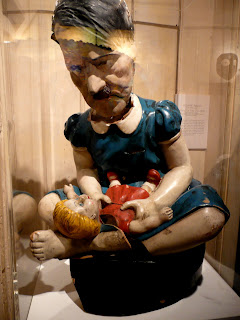
The rosy serenity did not last long however as my eyes adjusted to the dim surroundings and I saw the two little children-dolls in the far corner of the room. There was something very eerie about this work -- their little bodies, dressed in innocent frilly nightgowns were turned away, facing the corner. What are they hiding? Are they afraid? Or have they been naughty little demons perhaps? A more aggressive sculpture, made out of babies’ heads confirmed the slightly chilling ambiance, which began to infiltrate the room, as I started to take note of the other presences; a rucksack made in the shape of the all seeing Masonic eye, a miniature coffin with a dead doll next to that, a dark figure playing with a marionette, and a life sized totem-like structure made out of hair. This was one twisted little nursery. I wanted to stay and play.
Two floors down, the basement, with its sterile white light was a completely different experience all together. Actually it didn’t offer much compared to the attic, only foul smells of bubbling beeswax, which seemed more like burning plastic and a few works on walls. Its not that they were bad; the works themselves can be appreciated in their genre, but rather it was the experience, or lack of it that I found dissatisfying. I did not want to stand back and look at pictures. Hooked on sensory stimulation, all I wanted to do was go back upstairs, to the warped womb of a room, and feel. There should definitely be more little rooms arousing the senses around.
Whether it is visual, mental or nasal stimulation that you seek, the show fulfils that role with sensory tricks and spooky twists along the way. You can even practice a bit of hoochie coochie in the communal wishing machine provided, without having to invest in one yourself like William Burroughs. Concerned with the mystery of the creative act, achieved through heightened states of consciousness (and unconsciousness) the rich variety of work on display encompasses the term art in all the senses of the word. Satisfaction guaranteed.
Jan 19th - April 4th 2009, Riflemaker, Beak Street.